
Deep Learning · Supervised learning
Convolutional Neural Networks
Neural networks that scan images with small filters to recognize edges, shapes, and objects.
Category
Deep Learning
Learning type
Supervised
Complexity
High
Interpretability
Low
Overview
What convolutional neural networks does
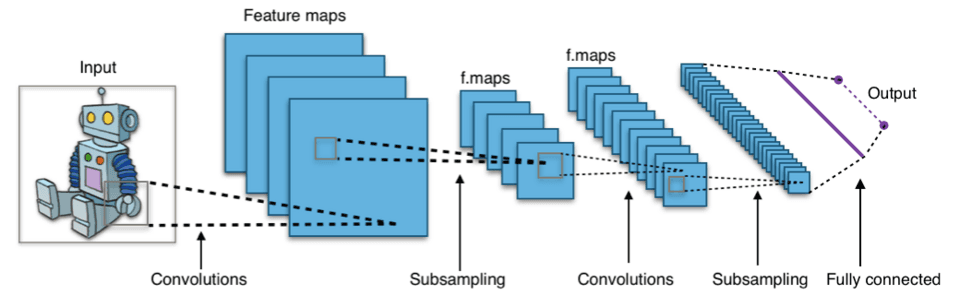
A convolutional neural network (CNN) is a neural network designed for grid-shaped data such as images. Instead of connecting every pixel to every unit, it slides small learned filters across the image to detect local patterns, then pools the results to keep what matters. Early layers find edges and textures; deeper layers combine them into parts and whole objects.
Formula
S(i, j) = Σₘ Σₙ I(i + m, j + n) · K(m, n)
Quick profile
Data it needs: Thousands of labeled images, fewer with a pretrained model
Process
How it works, step by step
- 1
Slides learned filters (kernels) across the image to produce feature maps
- 2
Applies an activation function so the network can model non-linear patterns
- 3
Pools neighboring values to shrink the maps and make detection robust to small shifts
- 4
Stacks convolution and pooling layers so later layers see larger, more abstract patterns
- 5
Flattens the final maps into fully connected layers that output a class or value
Worked example
Photo-based damage triage
A restoration company's technicians upload job-site photos. A CNN fine-tuned on past jobs tags the damage type and severity, so the office can schedule the right crew and equipment before anyone calls back.
When to use it
- For image classification, detection, or segmentation
- When spatial patterns matter more than individual values
- For video frames, scans, and document images
- When you can start from a pretrained model and fine-tune it
- For audio spectrograms and other grid-like signals
Strengths
- State-of-the-art accuracy on visual tasks
- Far fewer parameters than a fully connected network on images
- Robust to where an object appears in the frame
- Pretrained models make small datasets workable
- Learns visual features without hand engineering
Limitations
- Needs many labeled images or a good pretrained base
- Training usually requires GPUs
- Can fail on images unlike its training data
- Hard to explain individual decisions
- Sensitive to lighting, angle, and image quality changes
Applications
Where it is used
Related models
All 22 models
Need a model built on your data?
Tell us the decision you want to improve. We will tell you whether your data can support it and which approach fits.